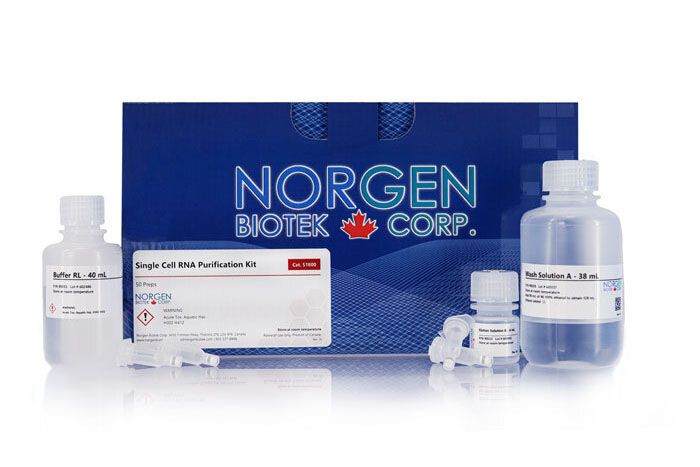
Single Cell RNA Purification Kit
Rapid purification of total RNA - including microRNA - from small input amounts

For research use only and NOT intended for in vitro diagnostics.
Single Cell RNA Purification Kit
Rapid purification of total RNA - including microRNA - from small input amounts
Register today to receive an exclusive 15% off* on your first order.
Features and Benefits
- Fast and easy processing using rapid micro spin column format
- Small elution volume of 8µL ready for direct utilization in qRT-PCR reactions
- Isolate total RNA including microRNA in a concentrated ready-to-use format
- Isolate high quality total RNA from a variety of sources
- RNA can be isolated from a single cell to 100,000 cells
- Purification is based on spin column chromatography that uses Norgen’s proprietary resin separation matrix
Very sensitive kit designed to work with as low as a single cell and up to 100,000 cells. The special design of the micro spin-column allows a small elution volume of as little as 8 µL.
Rapid 15 minute method for the isolation and purification of total RNA (including miRNA) from small input amounts of cultured animal cells, CTC, stem cells, immuno-sorted cells, and microdissected samples including laser-capture microdissection (LCM). The purified RNA is of the highest purity and integrity, and can be used in a number of qRT-PCR and digital PCR and other whole transcriptome applications.
Details
Supporting Data
Figure 1. Better Efficiency of RNA Recovery at Single Cell Input. Norgen’s Single Cell RNA Purification Kit allows sensitive RNA extraction from as little as a single cell and outperforms competitor’s kits that claim similar sensitivity. Total RNA was extracted from a decreasing number of HeLa cells using Norgen’s Single Cell RNA Purification Kit and a competitor’s spin column purification kit. The extracted RNA was subjected to RT-qPCR to detect the human S15 and 5S rRNA transcript in the isolated RNA. RNA isolated by Norgen’s Single Cell RNA Purification Kit showed much higher relative expression of each RNA transcript tested at all cell input numbers down to single cell.
Figure 2. High Quality RNA Isolated from Laser-Captured Microdissection (LCM). Norgen’s Single Cell RNA Purification Kit allows sensitive but high-quality RNA extraction from small inputs such as Laser-Captured Microdissection (LCM). Total RNA was isolated from 6 different LCM samples. RNA yield and quality (260/280 ratio) were assessed by NanoVue spectrophotometry. Norgen’s Single Cell RNA Purification Kit recovered good amounts of RNA with an excellent 260/280 ratio.
Figure 3. Consistent and Linear Recovery of All Sizes of RNA down to Single Cell Input. Norgen’s Single Cell RNA Purification Kit allows sensitive RNA extraction from as little as a single cell with great linearity. Total RNA was extracted from a decreasing number of HeLa cells using Norgen’s Single Cell RNA Purification Kit. The extracted RNA was subjected to RT-qPCR to detect all sizes of RNA, including the human S15 (mRNA), 5S rRNA transcript (small RNA), and miR-21 (microRNA). RNA isolated by Norgen’s Single Cell RNA Purification Kit showed very high consistency (over 99%) of recovery of each RNA transcript tested at all cell input numbers down to a single cell.
|
Kit Specifications
|
|
|
Maximum Column Binding Capacity
|
10 μg
|
|
Maximum Column Loading Volume
|
650 μL
|
|
Minimum Elution Volume
|
8 μL |
| Size of RNA Purified |
All sizes, including small RNA (<200 nt)
|
|
Maximum Amount of Starting Material: Animal Cells Laser-Captured Microdissection (LCM) |
Single Cell to 2 x 10⁵ cells Up to 2 x 10⁵ cells |
|
Time to Complete 10 Purifications
|
20 minutes
|
|
Average Yield HeLa Cells (1 x 10⁵ cells) HeLa Cells (100 cells) HeLa Cells (1 cell) |
~ 1.5 µg ~ 1.5 ng ≥ 1pg |
Storage Conditions and Product Stability
All solutions should be kept tightly sealed and stored at room temperature. This kit is stable for 2 years after the date of shipment.
| Component | Cat. 51800 (50 preps) |
|---|---|
| Buffer RL | 40 mL |
| Wash Solution A | 38 mL |
| Elution Solution A | 6 mL |
| Single Cell RNA Spin Columns | 50 |
| Collection Tubes | 50 |
| Elution Tubes (1.7 mL) | 50 |
| Product Insert | 1 |
Documentation
FAQs
Spin Column
Poor RNA recovery could be due to one or more of the following:
- Incomplete lysis of cells or tissue
Ensure that the appropriate amount of Buffer RL was used for the amount of cells or tissue.
- Column has become clogged
Do not exceed the recommended amounts of starting materials. The amount of starting material may need to be decreased if the column shows clogging below the recommended levels. See FAQ related to “Clogged Column” below.
- An alternative elution solution was used
It is recommended that the Elution Solution A supplied with this kit be used for maximum RNA recovery.
- Ethanol was not added to the lysate
Ensure that the appropriate amount of ethanol is added to the lysate before binding to the column.
- Ethanol was not added to the Wash Solution A
Ensure that 90 mL of 96-100% ethanol is added to the supplied Wash Solution A prior to use.
- Low RNA content in cells or tissues used
Different tissues and cells have different RNA contents, and thus the expected yield of RNA will vary greatly from these different sources. Please check literature to determine the expected RNA content of your starting material.
- Cell Culture: Cell monolayer was not washed with PBS
Ensure that the cell monolayer is washed with the appropriate amount of PBS in order to remove residual media from cells.
- Laser-Captured Microdissection: Sample was not incubated at 42°C for 30 minutes
Ensure that the incubation at 42°C for the removal and lysis of cells from the thermoplastic film.
Column clogging can result from the centrifuge temperature is too low. Ensure that the centrifuge remains at room temperature throughout the procedure. Temperatures below 15°C may cause precipitates to form that can cause the columns to clog.
If the RNA does not perform well in downstream applications, it may be due to one or more of the following:
- RNA was not washed 3 times with the provided Wash Solution A.
Traces of salt from the binding step may remain in the sample if the well is not washed 3 times with Wash Solution A. Salt may interfere with downstream applications, and thus must be washed from the well.
- Ethanol carryover.
Ensure that the dry spin under the Column Wash procedure is performed in order to remove traces of ethanol prior to elution. Ethanol is known to interfere with many downstream applications.
RNA can be degraded due to the following factors:
- RNase contamination.
RNases may be introduced during the use of the kit. Ensure proper procedures are followed when working with RNA. Please refer to “Working with RNA” at the beginning of this user guide.
- Procedure not performed quickly enough.
In order to maintain the integrity of the RNA, it is important that the procedure be performed quickly.
- Improper storage of the purified RNA.
For short term storage, RNA samples may be stored at –20℃ for a few days. It is recommended that samples be stored at –70℃ for longer term storage.
- Frozen tissues or cell pellets were allowed to thaw prior to RNA isolation.
Do not allow frozen tissues to thaw prior to grinding with the mortar and pestle in order to ensure that the integrity of the RNA is not compromised.
- Starting material may have a high RNase content.
For starting materials with high RNase content, it is recommended that β-mercaptoethanol be added to the Buffer RL.
Genomic DNA contamination could occur if large amount of starting material used. Perform RNase-free DNase I digestion on the RNA sample after elution to remove genomic DNA contamination. It is recommended that Norgen’s RNase- Free DNase I Kit (Product # 25710) be used for this step.
Every 100 µL of Buffer RL can only accept up to 30 µL of more liquid.
- For sorted cells with high volume, it is recommended to pellet them gently, resuspend in an appropriate smaller volume, and then proceed with the correct volume of Buffer RL.
- 350 µL of Buffer RL can be added to a 100 µL sample.
Yes, add buffer RL, vortex to lyse sample and then store at -80°C.
Yes, the kit provides enough extra volume of the elution solution to do this. We recommend checking the concentration of each elution separately before deciding to combine them.
Citations
| Title | A retinoid analogue, TTNPB, promotes clonal expansion of human pluripotent stem cells by upregulating CLDN2 and HoxA1 |
| Citation | Nature communications biology 2024. |
| Authors | Suman C. Nath, Shahnaz Babaei-Abraki, Guoliang Meng, Kali A. Heale, Charlie Y. M. Hsu & Derrick E. Rancourt |
| Title | Allele-specific antisense oligonucleotides for the treatment of BEST1-Related dominantly inherited retinal diseases: An in vitro model |
| Citation | Experimental Eye Research 2024. |
| Authors | Beren Karaosmanoglu a, Gozde Imren a, Eda Utine b, Hande Taylan Sekeroglu c, Ekim Z. Taskiran |
| Title | The intestinal microbiota modulates the transcriptional landscape of iNKT cells at steady-state and following antigen exposure |
| Citation | Mucosal Immunology 2024. |
| Authors | Qiaochu Lin 1, Meggie Kuypers 1, Yuriy Baglaenko 2, Eric Cao 1, Kebria Hezaveh 1 3, Tijana Despot 1, Carolina de Amat Herbozo 1, Mayra Cruz Tleugabulova 1, Juan Mauricio Umaña 1, Tracy L. McGaha 1 3, Dana J. Philpott 1, Thierry Mallevaey 1 |
| Title | IL-23 Exerts Dominant Pathogenic Functions in Crohn's Disease-Ileitis |
| Citation | Mucosal Immunology 2024. |
| Authors | Lida Iliopoulou a, Erifili Lianopoulou a, George Kollias |
| Title | Application of Elevated Atmospheric Pressure and Hypoxia Enhance Pluripotency and Stem Cell Differentiation. |
| Citation | Biorxiv Preprints 2024. |
| Authors | Zachary Pappalardo1,2 , Bryan Downie1 , Bruce A. Adams1,3 , and James Lim1,3 |
| Title | CD74 supports accumulation and function of regulatory T cells in tumors |
| Citation | Nature communications 2024. |
| Authors | Elisa Bonnin, Maria Rodrigo Riestra, Federico Marziali, Rafael Mena Osuna, Jordan Denizeau, Mathieu Maurin, Juan Jose Saez, Mabel Jouve, Pierre-Emmanuel Bonté, Wilfrid Richer, Fabien Nevo, Sebastien Lemoine, Nicolas Girard, Marine Lefevre, Edith Borcoman, Anne Vincent-Salomon, Sylvain Baulande, Helene D. Moreau, Christine Sedlik, Claire Hivroz, Ana-Maria Lennon-Duménil, Jimena Tosello Boari & Eliane Piaggio |
| Title | Patient-derived tumoroids of advanced high-grade neuroendocrine neoplasms mimic patient chemotherapy responses and guide the design of personalized combination therapies |
| Citation | |bioRxiv|Europe PMC 2023. |
| Authors | Aurel Perren; Simon April-Monn; Katharina Detjen; Philippe Kirchner; Konstantin Bräutigam; Mafalda Trippel; Tobias Grob; Cyril Statzer; Renaud Maire; Attila Kollàr; Aziz Couchane; Catarina Kunze; David Horst; Martin Sadowski; Jörg Schrader; Ilaria Marinoni; Bertram Wiedenmann |
| Title | MDR1-expressing CD4+ T cells with Th1.17 features resist to neoadjuvant chemotherapy and are associated with breast cancer clinical response |
| Citation | Journal for immunotherapy of cancer 2023. |
| Authors | Anthony Di Roio, Margaux Hubert, Laurie Besson, Marion Bossennec, Céline Rodriguez, Yenkel Grinberg-Bleyer, Guilhem Lalle, Lyvia Moudombi, Raphael Schneider, Cyril Degletagne, Isabelle Treilleux, Daniel Campbell, Séverine Metzger, Thomas Duhen, Olivier Tredan, Christophe Caux, Christine Ménétrier-Caux |
| Title | Slow-cycling murine melanoma cells display plasticity and enhanced tumorigenicity in syngeneic transplantation assay |
| Citation | Neoplasia (New York, N.Y.) 2023. |
| Authors | Anna Kusienicka, Maciej Ciesla, Karolina Bukowska-Strakova, Witold Norbert Nowak, Iwona Bronisz-Budzynska, Agnieszka Seretny, Monika Zukowska, Mateusz Jez |
| Title | Universal method for the isolation of microvessels from frozen brain tissue: A proof-of-concept multiomic investigation of the neurovasculature |
| Citation | Brain, Behavior, & Immunity - Health 2023. |
| Authors | Marina Wakid, Daniel Almeida, Zahia Aouabed, Reza Rahimian, Maria Antonietta Davoli, Volodymyr Yerko, Elena Leonova-Erko, Vincent Richard, René Zahedi, Christoph Borchers, Gustavo Turecki, Naguib Mechawar. |